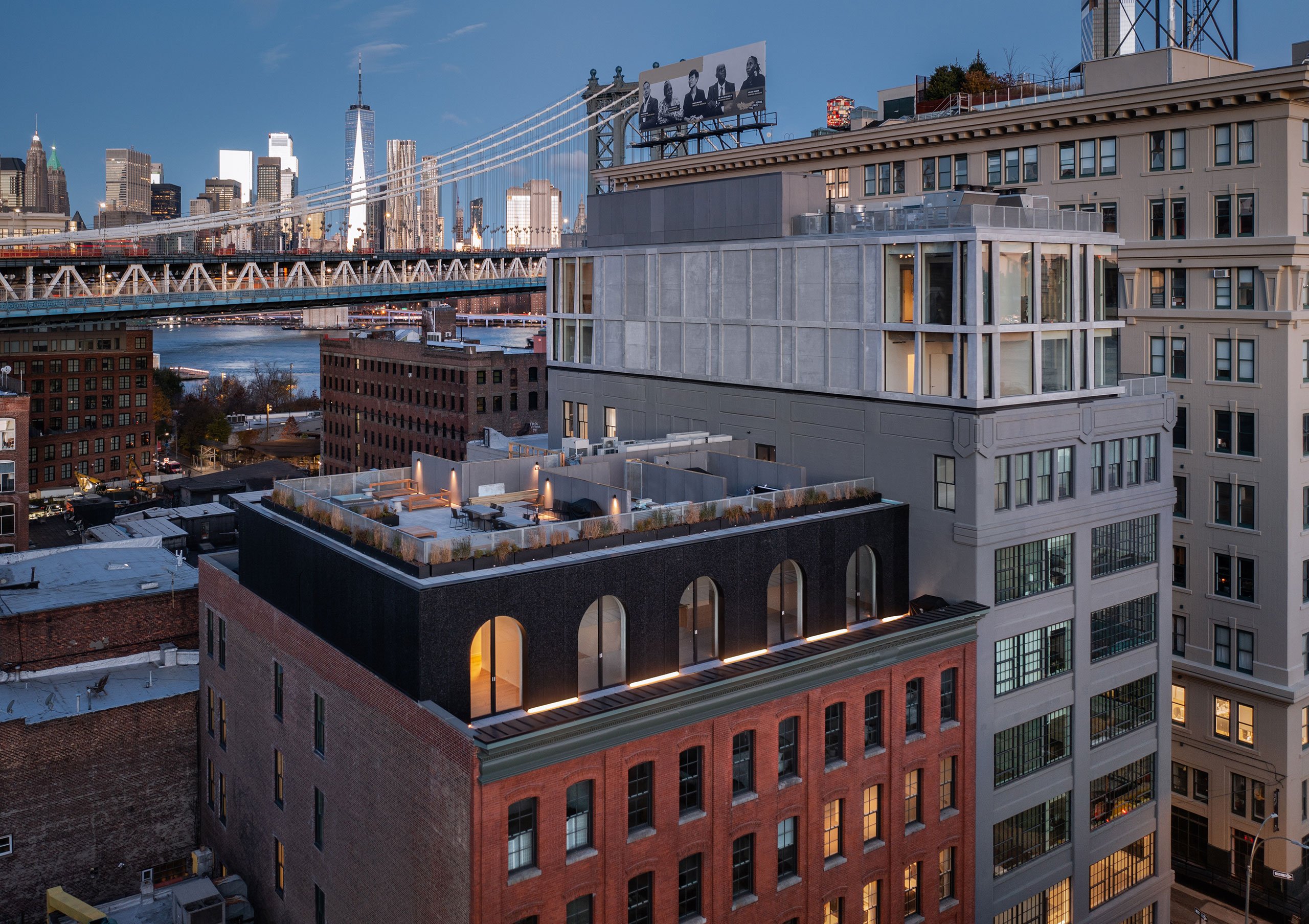
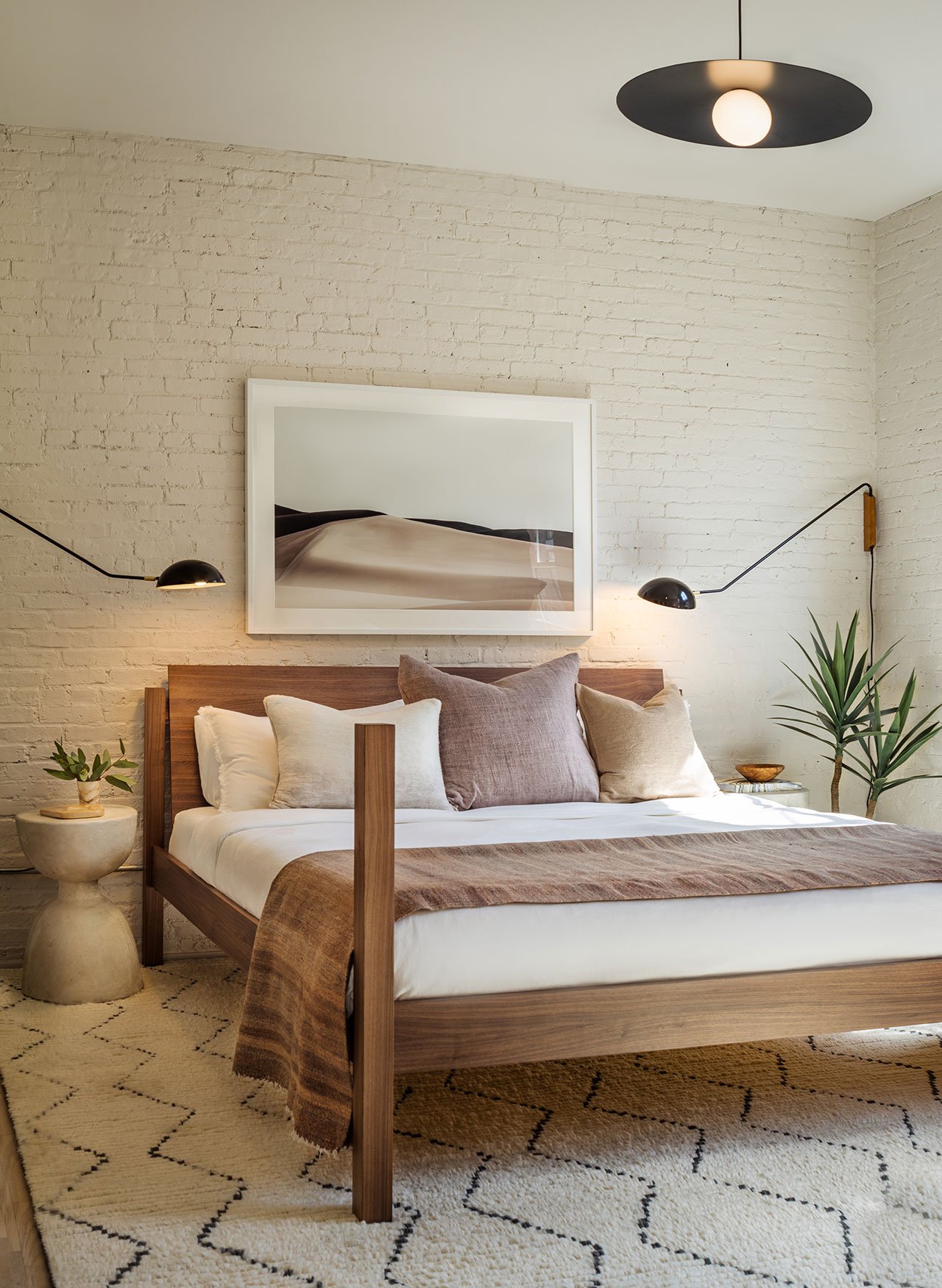
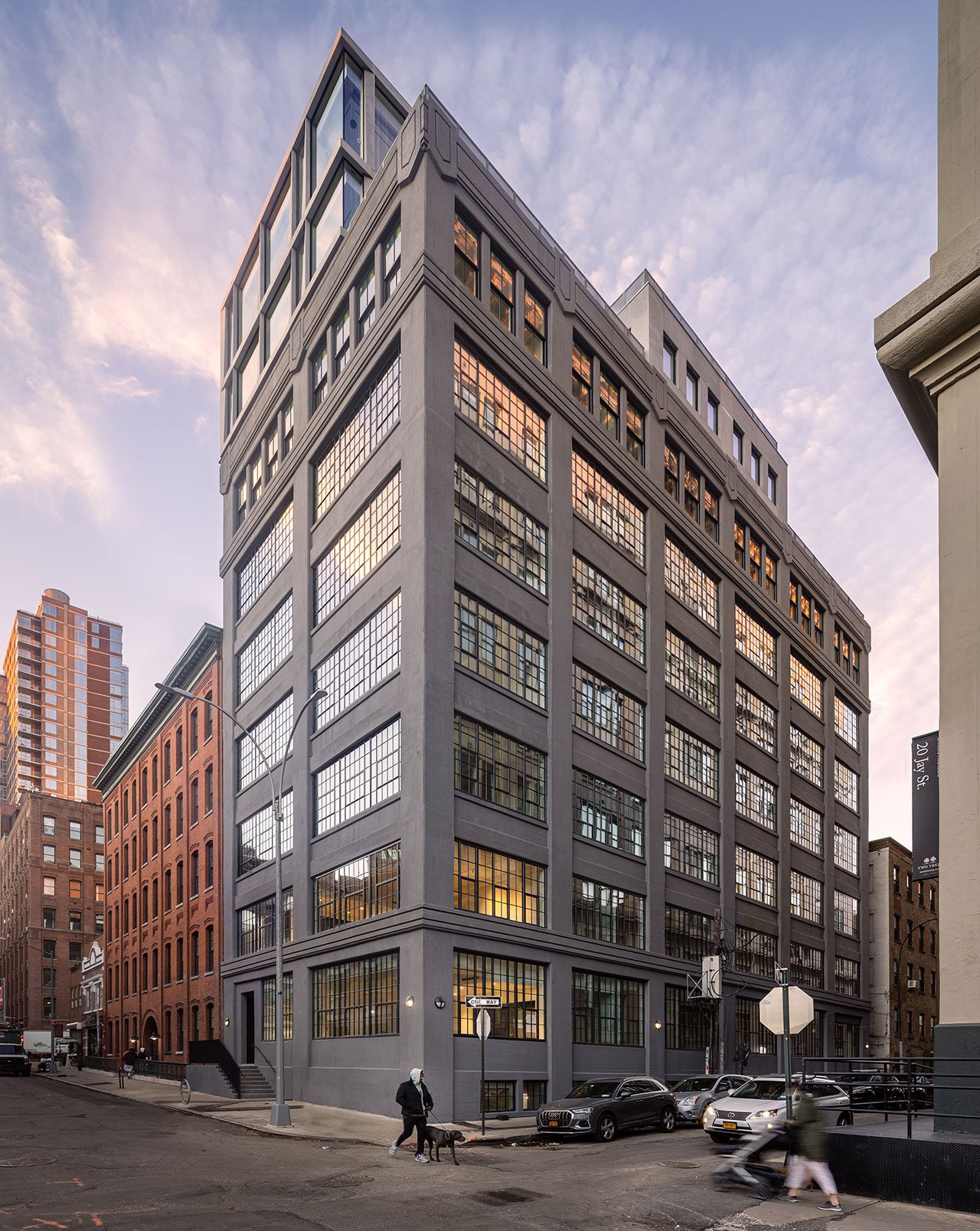
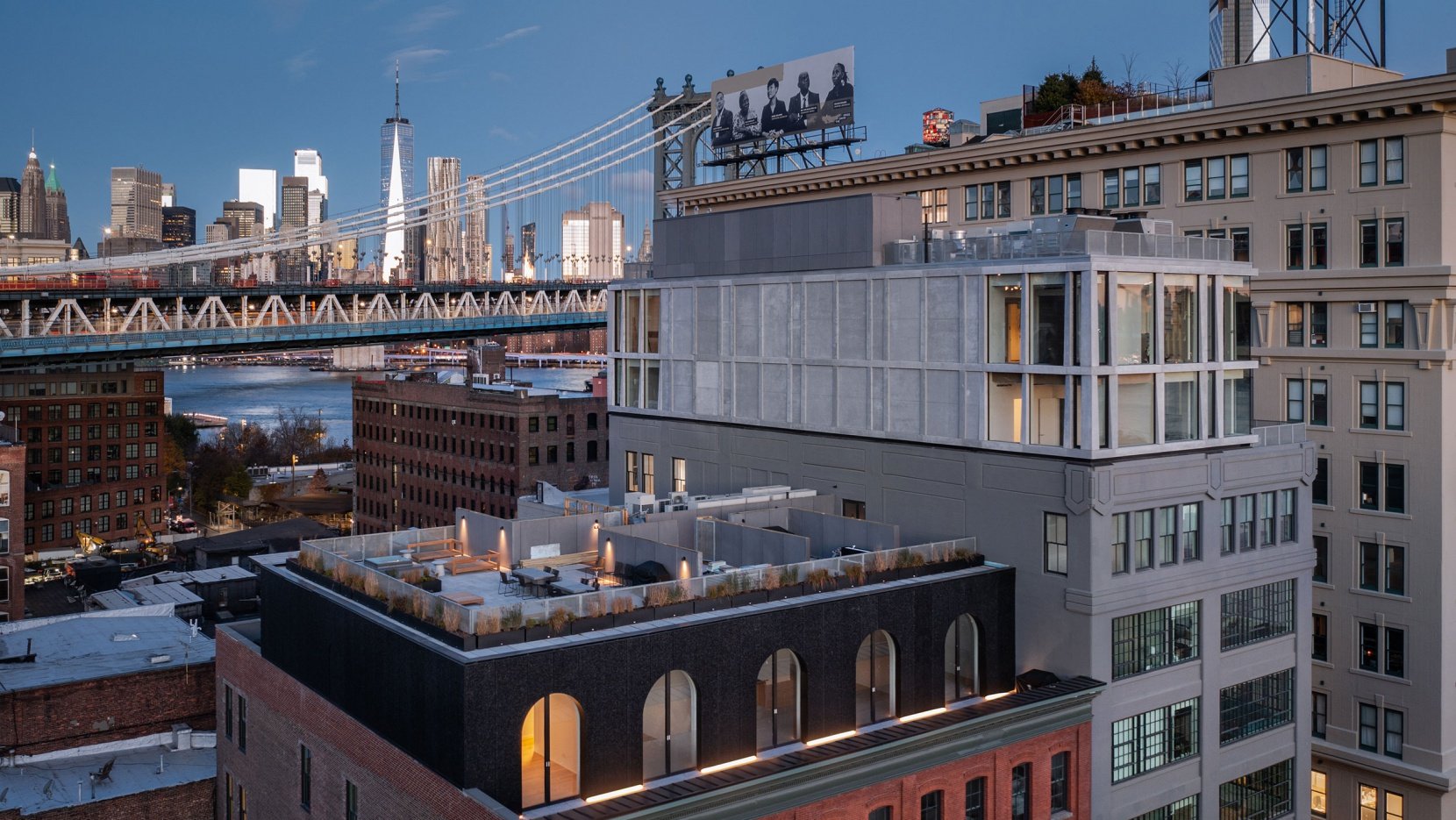
Located in Dumbo, one of Brooklyn’s most exclusive enclaves where New York’s industrial past meets modern urban living, 168 Plymouth is an ambitious loft conversion project that incorporates two distinct industrial buildings, a brick and timber structure erected in 1891 and a concrete structure built thirty years later. Developed and designed by local real estate development company Alloy, the project comprises 46 airy, light-filled homes that range from one-bedroom apartments, to two-storey townhouses and expansive penthouses. Featuring two contemporary additions, plus a landscaped courtyard, communal rooftop deck, private terraces and a fitness space, the development showcases how historic renovations and modern design are not mutually exclusive.
Nestled around the Brooklyn and Manhattan bridges, Dumbo, an acronym for ‘Down Under the Manhattan Bridge Overpass’, has evolved over the last few decades from a grim 19th century manufacturing district into a hip neighbourhood teeming with luxury lofts, trendy boutiques and digital start-ups. Blessed with scenic Manhattan views, the waterfront neighbourhood is nevertheless imbued with an old New York sensibility thanks to its cobblestone streets etched with railroad tracks and historic factories and warehouses which have been converted into apartments, art galleries, restaurants and co-working spaces.

Name
---
Project
168 Plymouth: New York’s Industrial Past Meets Modern Urban Living
Images
---
Words
---
Featuring a triangular layout, the Museum has been designed, in Chief architect and founder of Wutopia Lab Yu Ting’s words, as a “slowly unfolding hand scroll” with functional spaces lining the perimeter and a black reflecting pool in the centre. Varying in both thickness and transparency, the building’s gently curving perimeter zone connects three monolithic volumes that seem to float on the reflecting pool: an oval-shaped concrete volume containing a small theatre, a glass cube housing a dance studio, and a cylindrical “glittering glass fortress” where yoga sessions take place. Unlike the three symmetrical volumes, the perimeter zone is organically shaped, widening to accommodate spaces such as the art gallery and tea room, with narrower sections serving as corridors.
Inspired by the brushstrokes used in Chinese painting, the boundary walls shift from continuous floor-to-ceiling glazing (made possible by a slender cast-concrete ceiling slab supported by steel beams concealed within internal walls), to solid walls, through to latticework, forming “a shifting ink line”, as Ting points out. The variation in transparency, which can also be found in the pool-facing wall sections, enhances the Museum’s sculptural design but also serves a more practical reason, namely controlling natural light and views according to functionality.
As the most introverted of all the spaces, the theatre’s solid volume is punctured only by a curved skylight that allows both sun and moonlight to spill into the cavernous space like a “waterfall”. On the contrary, the glass-enclosed dance and yoga studios are inundated with natural lighting, with the former clad in translucent glazing panels for privacy, and the way in which latter enveloped in red-to-blue ombré glass, an unexpected gesture that adds a welcoming splash of colour in the otherwise monochromatic colour scheme.
The choreographed circulation of visitors around the central reflection pool is echoed by a sinuous flowing water channel that Ting describes as “a surging current in the calm water courtyard”. Beginning as a fountain, the channel spirals and twists its way across the vast pool before it disappears below the yoga space, coursing through the building’s foundation and finally emptying out of sight into the Yellow Sea. The stream’s ethereal sensibility is matched by the encircling “flower” wall, a lattice construction made with curved concrete blocks, and six trees that seem to grow out of the pool, a reference to a landscape painting by the Yuan dynasty artist Ni Zan – ultimately providing another facet in how the Museum has succeeded in paying tribute to both traditional Chinese landscape painting and zen sculpture gardens.